

My long career as a teacher means that I have seen any number of lunatic educational experiments come and go. As a student in 1964, the Initial Teaching Alphabet was all the rage. (‘Rage’ being an appropriate word. It was not particularly effective. As John Walker, director of Sounds-Write says in his excellent blog, “Talk to anyone today who was taught to read through i.t.a. and they will almost invariably tell you how they’ve never been able to spell correctly since.”)
By the end of my career, pupils (and some teachers – i.e. me) were struggling with the joys of THRASS, a system for teaching learners about the building blocks of reading and spelling – the 44 phonemes (speech sounds) of spoken English and the graphemes (spelling choices) of written English. It gave me flashbacks to the Initial Teaching Alphabet.
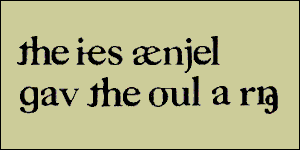
Source: news.bbc.co.uk/1/hi/uk/1523708.stm
Add to the mix any educational policy – any – associated with Michael Gove, and the shambolic result is second only to the deranged decision in the 1980s to stop teaching children more than the absolute basics of grammar – the set of structural rules of the English language; the ways we put words together in sentences to form meaning. Grammar was reintroduced into the National Curriculum for UK primary schools in the late 1980s. Reports from the front line (and Twitter) make me wonder if things have swung too far in the opposite direction when children are expected to understand things we as parents and grandparents have never heard of. Fronted adverbial, anyone? Author Michael Rosen is not a fan.
I thought the ditching-of-grammar decision was a nonsense so my pupils were taught about the structure of words, phrases, clauses, sentences and whole texts. While I was surreptitiously sneaking coordinating conjunctions into my lessons, many teachers were joyfully casting off their corsets. Some went further, interpreting the embargo on grammar as a licence to ignore punctuation while they were at it.
Why do I care now that I am happily (very happily) retired from teaching? It’s passion, dear reader. Passion for clear, elegant, expressive, nuanced writing. A good grasp of grammar and punctuation is invaluable, and so many people lost out in this regard.
My creative writing courses have shown me how much younger writers are troubled by the results of this particular educational tomfoolery. They feel unconfident. One of the biggest problem areas is around the writing of conversation – so much so that I wrote a brief guide. It’s not definitive, and it’s rooted in how I was taught back in the Dark Ages, but you just might find it useful.
Direct and Indirect Speech
You can answer the question What did she say? in two ways:
- by repeating the words spoken (direct speech)
- by reporting the words spoken (indirect or reported speech)
Direct Speech
Direct speech repeats, or quotes, the exact words spoken. When we use direct speech in writing, we place the words spoken between quotation marks (” “), also called inverted commas, and there is no change in these words. The formatting conventions in writing plays are different, but essentially a play consists of direct speech with stage directions.
Reported or indirect speech
Reported or indirect speech is usually used to talk about the past, so we normally change the tense of the words spoken. We use reporting verbs like ‘say’, ‘tell’, ‘ask’, and we may use the word ‘that’ to introduce the reported words. Inverted commas are not used.
Avril and her friend Jenny were talking about the writing class they were both involved with. Avril said that this week she would be discussing how to record the spoken word. Jenny laughed as she remarked that it is necessary in novels and plays to leave out all the ‘Ums’ and ‘Ahs’ and other irritating speech habits that we all have. Avril agreed.
“There is a balance between making dialogue realistic,” she said, “and keeping it readable. Natural conversation, if recorded completely accurately, is not very interesting to read.”
“Not only that,” said Jenny. “Some authors have a tendency to give their characters lengthy monologues. Particularly when there is a lot of information they want to get across.”
“Fat chance of getting a lengthy monologue in this conversation!” laughed Avril. “You’re right, though. Even if one character does have a lot to say, the canny writer puts in breaks so that it’s not an overwhelming mass of text.”
“How often do you put in the name of the speaker?” questioned Jenny.
“That’s an interesting question. Too many insertions of ‘said Avril’, ‘said Jenny’, ‘said Avril’, ‘said Jenny’ are incredibly repetitive and tedious. But if you don’t put any at all then it’s easy to lose track of who is saying what. It spoils the flow of the story if you have to keep on going back and working out who is actually speaking at any given time.”
Jenny remarked that she tried to use alternatives to the word ‘said’. She compiled a very long list of possibilities, including: remarked, suggested, shouted, laughed, explained, whispered, hinted and snarled. She also mentioned that you can put ‘Avril said’ at the start or end of direct speech, or even in the middle, as long as you keep track of the punctuation.
“I find it helps if I read what I’ve written out loud,” observed Avril.
Jenny agreed. “Me too! Then I know if the rhythm of the piece is right. Too many short sentences can be very abrupt: too many long ones get confusing. It’s a good way to check for repetition, as well.”
Avril suggested that sometimes you could break up a rather scrappy conversation by including reported or indirect speech – simply paraphrasing what had been said. Rather like this paragraph!
“What conventions do you prefer?” asked Avril.
“I tend to go with what I was taught at school,” replied Jenny. “I use quotation marks to contain all the dialogue and all the punctuation.”
“Same here,” said Avril. “And I start a new line for each speaker. But I notice a lot of writers nowadays use very different ways of recording speech. Some use a dash (–) and don’t bother with speech marks at all. I find that a bit confusing.”
“Some don’t seem to bother with even the dash!”
“I notice that some authors use single quote marks rather than double. I prefer to keep the single quote mark for a quote within the dialogue, like when I wrote ‘Avril said’ and ‘Jenny said.’”
“I see you needed three inverted commas there! My friend Ted would hate that. He’s a graphic designer, and sees blocks of text as images. He described speech marks as being like fly dirt on the page.” She rolled her eyes. “So who makes the rules?”
“Some publishers will tell you their ‘house style’, even down to the font and size. It’s worth having a look at the novels on your shelf for different examples. Until the glorious day that a publisher wants to print our work, let’s just decide what suits us best!”
This post originally featured on the Enterprising Writer blog on the 20th of May, 2022.
If you liked this post or found the information useful, please feel free to buy me a coffee. If you’d like to know how to set up ko-fi.com to receive donations yourself, please get in touch!





Leave A Comment